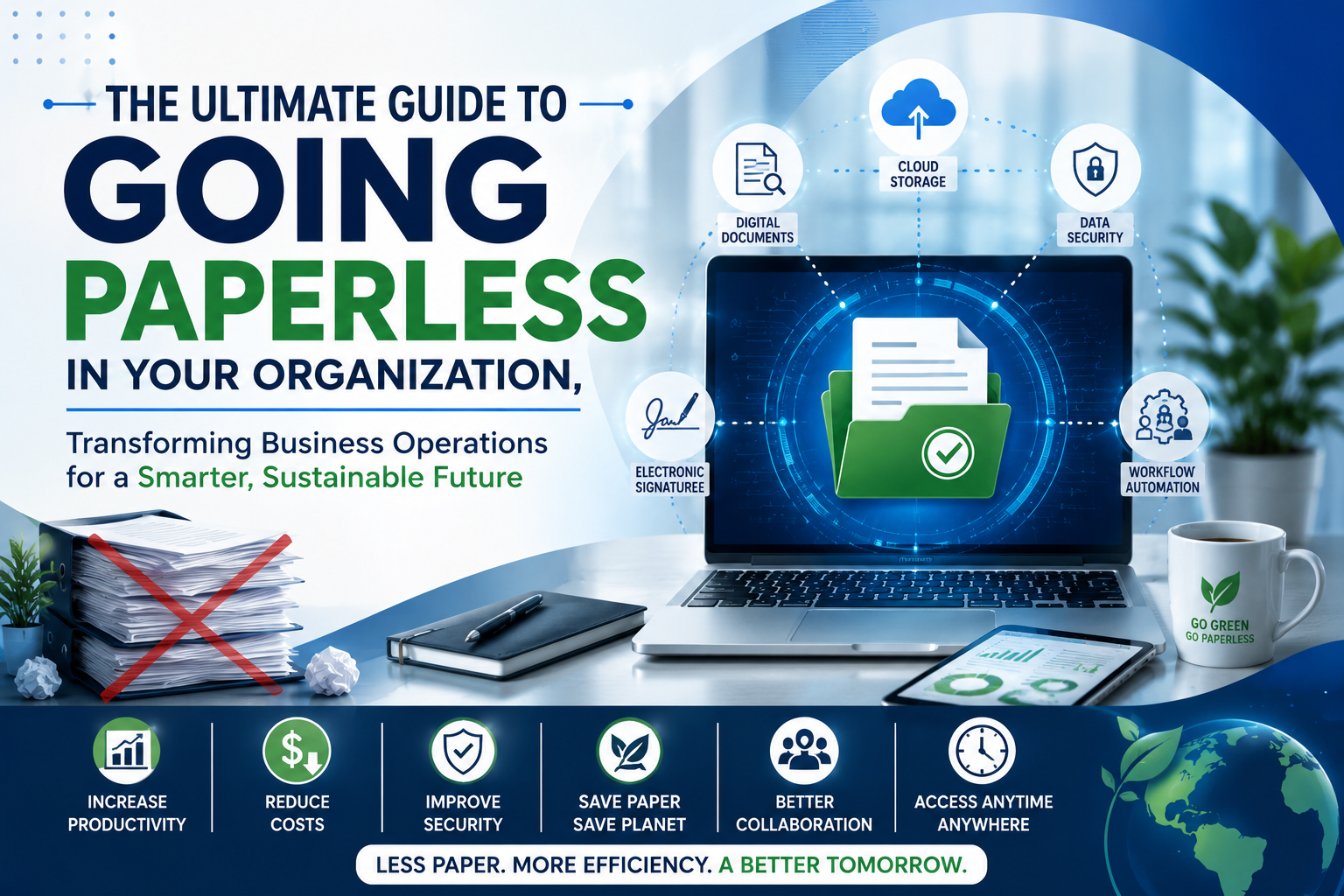
In today's world, where digital change is key to business success, moving to a paperless workplace is not just a futuristic goal—it’s a necessary step. Companies in various sectors are realizing that sticking to traditional paper processes clashes with the needs of modern operations where speed, teamwork, security, and sustainability matter most. Crammed filing cabinets, long approval times, lost papers, and rising printing costs slow down productivity and make it hard for a company to stay competitive in a changing market.
Going paperless means more than just switching paper documents for digital ones. It involves a deep change in how information is created, stored, shared, approved, and managed within a company. By using cloud computing, document management systems, workflow automation, electronic signatures, and secure digital storage, businesses can create processes that are faster, more efficient, and more resilient than traditional methods.
Companies that successfully adopt a paperless approach often see impressive gains in efficiency, collaboration among employees, adherence to regulations, customer service, and cost management. Additionally, cutting down on paper use shows a real commitment to environmental responsibility and helps reduce operational costs. As digital technologies keep advancing, adopting a paperless strategy has become a key investment for businesses looking to secure their futures.
Understanding a Paperless Organization
A paperless organization primarily manages business information through digital tools instead of physical documents. This includes contracts, invoices, employee records, financial reports, customer files, meeting notes, approval forms, and operational documents—all created, stored, accessed, and archived electronically. Employees work together using secure digital platforms that allow instant access to information from anywhere, cutting down on the inefficiencies tied to paper-based systems.
The goal isn’t to eliminate all paper—some industries may still need limited physical documents—but to lessen reliance on paper whenever possible. Digital systems offer centralized storage where authorized users can find information quickly instead of rummaging through filing cabinets. This easy access greatly improves decision-making, boosts productivity, and protects vital information from physical damage, loss, or decay.
Why Organizations Should Go Paperless
Traditional, paper-heavy operations come with many hidden costs. Beyond obvious expenses for paper, printers, ink, filing cabinets, and storage, businesses face significant indirect costs due to delays in retrieving documents, manual data entry, administrative time, lost records, and lengthy approval processes.
A paperless workplace changes these inefficiencies. Digital documents can be shared instantly, collaboratively edited, approved electronically, and safely archived without needing physical movement or manual filing. Employees can spend less time on repetitive administrative tasks and more time on strategic goals that deliver real business value.
Moreover, many organizations now work in hybrid and remote settings where easy access to information is crucial. Cloud-based document management allows employees to collaborate securely from almost anywhere, ensuring smooth business operations while keeping consistent standards.
Essential Technologies That Enable a Paperless Workplace
Successfully creating a paperless organization depends on several interconnected technologies working together to form a cohesive digital environment. Cloud storage platforms provide secure and scalable spaces for documents, enabling authorized users to access files from various devices. Document Management Systems (DMS) organize digital records with advanced indexing, version control, metadata classification, and search features, ensuring easy access to information throughout its lifespan.
Electronic signature platforms remove the need for printing and signing contracts, speeding up approval processes while keeping them legally valid. Workflow automation software simplifies repetitive tasks like invoice approvals, employee onboarding, procurement requests, and compliance reporting. Optical Character Recognition (OCR) technology transforms scanned documents into searchable digital files, allowing companies to keep historical records while making them easy to find.
Artificial Intelligence is improving processes like document classification, automated data extraction, predictive analytics, and intelligent workflow optimization, helping businesses manage increasing amounts of information more efficiently.
Steps to Successfully Transition to a Paperless Organization
Moving to a paperless workplace requires careful planning, execution, and commitment. The process starts with a thorough review of current document-heavy workflows to spot digitization opportunities. Companies should focus on processes that require a lot of administrative work or create bottlenecks.
After this assessment, organizations need to create standard document management policies covering file naming, storage structures, access permissions, retention schedules, and backup plans. Existing paper records should then be digitized with high-quality scanning tools and OCR software to form searchable electronic archives.
Choosing integrated digital platforms that support workflow automation, collaboration, electronic signatures, and secure cloud storage is crucial. Employee training should occur at every stage to ensure staff feel confident using new technologies while understanding cybersecurity best practices and document management policies.
Instead of trying to digitize every department at once, companies often succeed better with phased implementation, allowing for ongoing adjustments based on user feedback and performance.
Benefits of Going Paperless
Transitioning to a paperless organization brings major benefits across nearly every part of business operations. Efficiency jumps as employees gain quick access to information without digging through physical stores. Automated workflows cut administrative delays, speeding up approvals, improving customer responses, and enabling swifter decision-making.
Financial savings come from reduced spending on paper, printing supplies, storage costs, shipping services, and document logistics. Firms also lower labor costs tied to filing, retrieving, duplicating, and processing documents.
From a security standpoint, digital files often offer stronger protection than physical ones via encryption, role-based access controls, multifactor authentication, regular backups, and detailed audit trails. Sensitive data is much less vulnerable to theft, fire, water damage, or accidental loss.
Environmental sustainability is another significant advantage. Cutting back on paper use diminishes deforestation, energy consumption, greenhouse gases, and landfill waste while improving the organization's green credentials with customers, investors, and regulators.
The most notable benefits include:
* Major boosts in operational efficiency through automated workflow s, instant document access, quicker approvals, and improved collaboration across departments.
* Significant cuts in operational costs by reducing printing expenses, storage needs, administrative overhead, shipping costs, and paper use.
* Better information security and regulatory compliance through encrypted storage, comprehensive audit trails, controlled user access, regular backups, and secure document lifecycle management.
* Greater sustainability and resilience by reducing environmental impact while enabling secure remote work, disaster recovery, and continuous access to vital information.
Common Challenges and Practical Solutions
Despite its many benefits, moving to a paperless workplace has challenges. Employees may resist when established routines change due to new technologies. Therefore, effective change management, consistent communication, and thorough training programs are crucial for encouraging acceptance and building organizational confidence.
Legacy systems can also create integration issues, especially in organizations with outdated software. Choosing flexible platforms that can work with existing applications helps reduce disruptions during the transition.
Cybersecurity is another concern that needs careful consideration. Organizations must introduce strong security measures, including encryption, multifactor authentication, regular vulnerability checks, endpoint protection, and employee training on cybersecurity to protect sensitive digital assets.
Furthermore, reliable backup and disaster recovery plans must be in place to ensure critical business data stays safe from hardware failures, cyber threats, or unexpected disruptions.
Best Practices for Building a Successful Paperless Organization
Organizations should tackle digital transformation thoughtfully rather than viewing paper reduction as a stand-alone project. Having executive support, setting clear goals, and developing clear implementation plans greatly increase the likelihood of lasting success.
Regular audits should identify more chances for process optimization, remove redundant documents, and boost workflow efficiency. Companies should prioritize interoperability, selecting technologies that integrate smoothly with accounting systems, CRM platforms, enterprise resource planning software, and collaboration tools.
Ongoing employee education is vital. As digital tools change, organizations should offer continuous training that helps employees fully use new systems while ensuring strong cybersecurity habits.
Future Trends Shaping Paperless Organizations
The future of paperless workplaces will increasingly be driven by Artificial Intelligence, machine learning, smart document processing, predictive analytics, blockchain verification, and hyperautomation. AI systems will automatically classify documents, extract key information, identify irregularities, and suggest workflow enhancements with minimal human input.
Blockchain may further boost document authenticity by creating tamper-proof digital records, particularly for contracts, legal paperwork, healthcare records, and financial transactions. At the same time, advanced analytics will provide insights into operational performance, helping optimize document-focused business processes.
As remote work grows globally, cloud-based collaboration tools, smart automation, and secure digital environments will become core parts of organizational infrastructure, making traditional paper-based operations less relevant.
Conclusion
Going paperless is more than just a tech update—it’s a strategic change that fundamentally alters how organizations operate, collaborate, and compete. By replacing inefficient manual processes with smart digital systems, businesses gain agility, better information security, lower costs, higher employee productivity, and stronger commitments to environmental sustainability.