Online Signature vs Digital Signature: Best Choice for Business
In the modern digital economy, organizations are constantly looking for ways to streamline operations, reduce paperwork, and improve efficiency. One major transformation in business workflows is the shift from traditional paper-based signatures to electronic signing solutions.
Online Signature vs Digital Signature: Best Choice for Business
In the modern digital economy, organizations are constantly looking for ways to streamline operations, reduce paperwork, and improve efficiency. One major transformation in business workflows is the shift from traditional paper-based signatures to electronic signing solutions.
Two commonly used methods are online signatures and digital signatures. Although these terms are often used interchangeably, they represent different technologies and levels of security. Understanding the differences between them helps businesses choose the right solution for document authentication, compliance, and workflow automation.
This article provides a professional comparison of online signatures and digital signatures, including their features, benefits, use cases, and which option is best suited for modern businesses.
Understanding Online Signatures
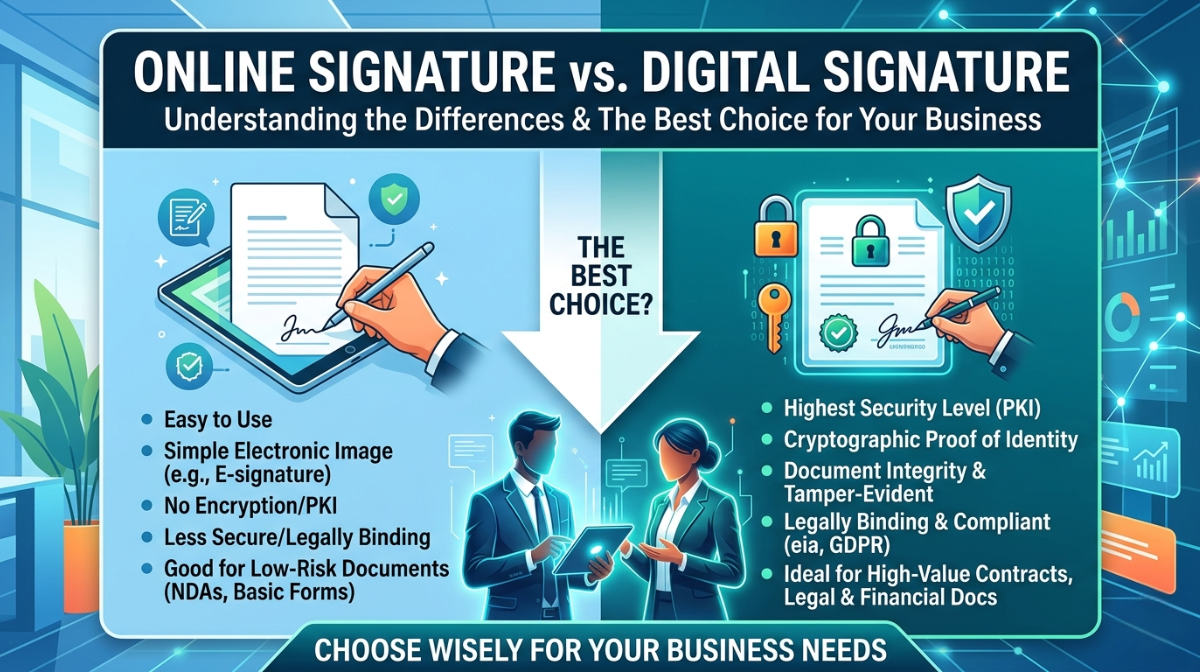
An online signature, often referred to as an electronic signature (e-signature), allows individuals to sign documents electronically through web-based platforms or software applications. Instead of physically signing a printed document, users can sign digitally by typing their name, drawing a signature with a stylus or mouse, or uploading an image of their signature.
Online signatures are widely adopted because they make document signing quick, simple, and accessible from anywhere.
Key Features of Online Signatures
- Ability to sign documents using computers, tablets, or smartphones
- Remote document access and signing
- Multi-party signing workflows
- Integration with cloud storage and CRM systems
- Automated notifications and reminders
Advantages of Online Signatures
1. Faster Business Processes
Documents can be signed instantly without printing, scanning, or mailing.
2. Improved Productivity
Teams can complete agreements and approvals in minutes rather than days.
3. Cost Reduction
Eliminates expenses related to printing, paper storage, and courier services.
4. Remote Accessibility
Employees and clients can sign documents from any location.
5. Better Customer Experience
Simplifies document handling for clients and partners.
Because of these benefits, online signatures are commonly used in sales contracts, HR documentation, vendor agreements, service contracts, and client onboarding forms.
Understanding Digital Signatures
A digital signature is a highly secure form of electronic signature that uses cryptographic technology to authenticate the identity of the signer and ensure the integrity of the document.
Digital signatures rely on Public Key Infrastructure (PKI) and digital certificates issued by trusted certification authorities. When a document is digitally signed, the system generates a unique encrypted code that links the signature to the document and the signer’s identity.
Key Features of Digital Signatures
- Advanced encryption technology
- Digital certificates for identity verification
- Tamper-evident document protection
- Time stamping and audit trails
- Compliance with regulatory standards
Advantages of Digital Signatures
1. High-Level Security
Digital signatures use encryption algorithms to protect documents from unauthorized changes.
2. Verified Signer Identity
The signer’s identity is authenticated using digital certificates.
3. Document Integrity
If a document is altered after signing, the system immediately detects it.
4. Regulatory Compliance
Digital signatures meet strict compliance requirements in many industries.
5. Strong Legal Validity
They are recognized by many governments and regulatory authorities for official transactions.
Digital signatures are widely used in legal agreements, financial documents, government filings, tax submissions, and compliance-related processes.
Key Differences Between Online Signatures and Digital Signatures
| Feature | Online Signature | Digital Signature |
|---|---|---|
| Definition | Electronic method of signing documents online | Cryptographic method of verifying signer identity |
| Security Level | Standard security | Advanced encryption security |
| Authentication | Basic identity confirmation | Verified identity using digital certificates |
| Document Integrity | Limited tamper detection | Strong tamper-proof protection |
| Compliance | Suitable for general business use | Required for regulated industries |
| Technology | Electronic signing platforms | PKI and digital certificate technology |
| Common Use Cases | Contracts, HR forms, agreements | Legal, financial, and government documents |
Business Use Cases for Online Signatures
Online signatures are ideal for businesses that prioritize speed, convenience, and efficiency. They are commonly used in scenarios such as:
- Sales and service agreements
- Vendor and supplier contracts
- Employment documents
- Non-disclosure agreements (NDAs)
- Client onboarding forms
- Internal approvals and workflow documentation
Companies that manage large volumes of documents daily often prefer online signature solutions because they streamline operations and improve turnaround time.
Business Use Cases for Digital Signatures
Digital signatures are best suited for situations where security, compliance, and authentication are critical.
- Government documentation
- Financial transactions and banking agreements
- Tax filings and regulatory submissions
- Legal contracts and court documents
- Healthcare records and compliance forms
- Corporate governance documentation
Industries such as banking, finance, healthcare, legal services, and government agencies frequently require digital signatures to ensure document authenticity and regulatory compliance.
Legal Validity of Online and Digital Signatures
Both online signatures and digital signatures are legally recognized in many countries. Regulations such as electronic transaction laws provide legal acceptance for electronically signed documents.
However, digital signatures often carry higher legal assurance because they include identity verification and encryption-based authentication.
Businesses should always ensure that their signature solutions comply with the relevant laws and regulations in their region.
Factors to Consider When Choosing the Best Option
- Security Requirements – If documents contain sensitive or regulated information, digital signatures may be the better choice.
- Document Volume – Businesses with high document volumes may benefit from the simplicity of online signatures.
- Compliance Needs – Certain industries require digital signatures to meet legal or regulatory standards.
- Workflow Complexity – Online signature platforms often offer automation features that improve document workflows.
- User Experience – Ease of use is important when documents must be signed by clients, partners, or employees.
Why Many Businesses Use Both
Many modern organizations adopt platforms that support both online signatures and digital signatures. This approach provides flexibility, allowing businesses to select the appropriate signature type depending on the document’s purpose and security requirements.
- Online signatures for everyday contracts and agreements
- Digital signatures for high-value or regulated documents
This hybrid approach helps companies maintain efficiency while ensuring compliance and security.
Conclusion
The shift toward electronic document signing has transformed the way businesses handle contracts and approvals. Both online signatures and digital signatures offer significant advantages over traditional paper-based processes.
Online signatures provide speed, convenience, and workflow efficiency, making them ideal for everyday business operations. Digital signatures, on the other hand, deliver advanced security, identity verification, and regulatory compliance, making them suitable for sensitive and legally critical documents.
Choosing the right solution depends on your organization’s security requirements, compliance obligations, and document management needs. By adopting the appropriate signing technology, businesses can enhance productivity, improve security, and accelerate digital transformation.
About the author

Santosh Shet
Santosh Shet is the Founder of Appyminds and a technology entrepreneur with over 20 years of experience in software development, web applications, mobile apps, AI solutions, and business automation. He helps businesses transform ideas into scalable digital products through modern web development, mobile applications, intelligent automation, and AI-powered solutions. Santosh regularly writes about artificial intelligence, software development, digital transformation, SaaS products, and emerging technology trends.