How Digital Workflows Improve Business Productivity
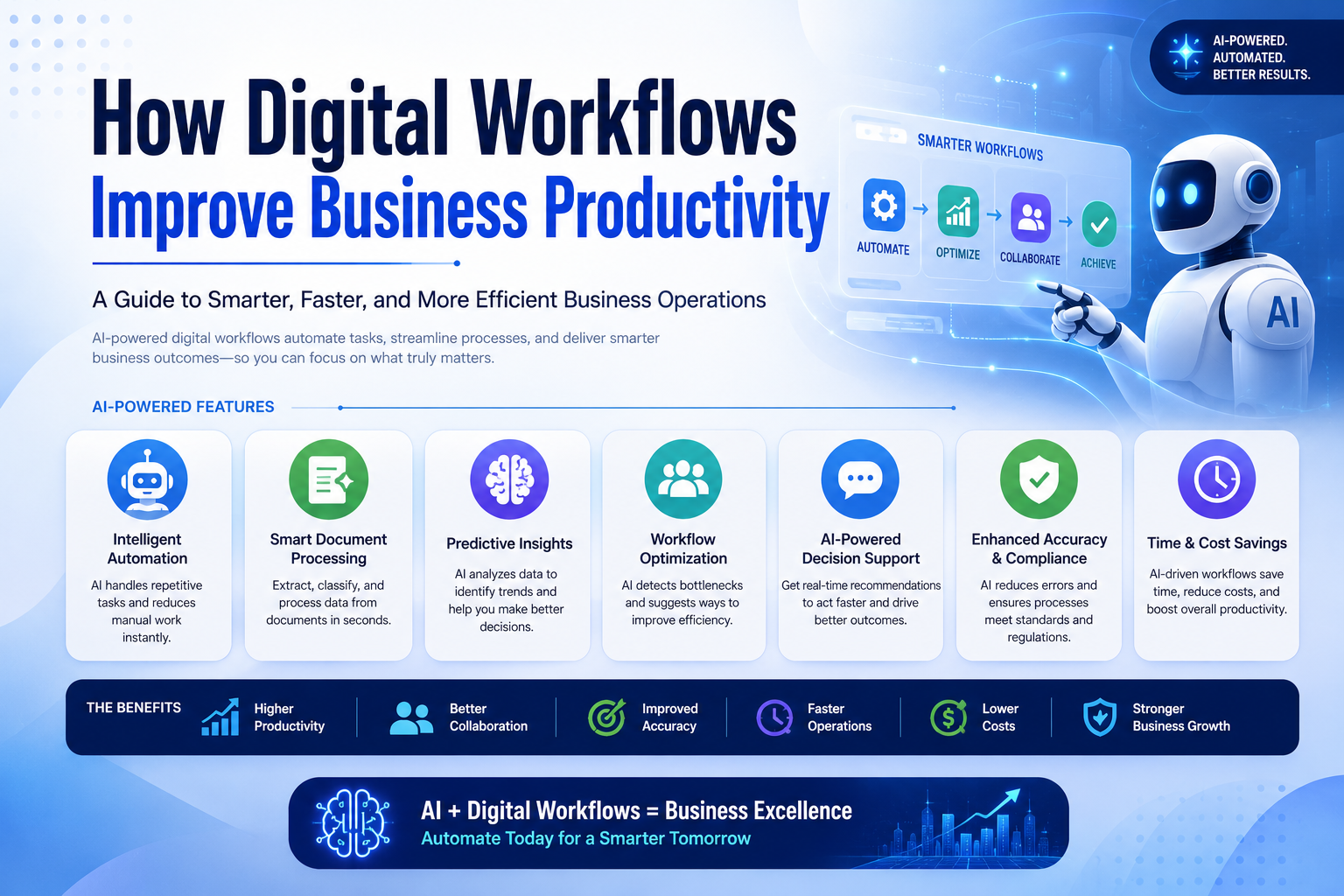
By replacing manual tasks with automated digital workflows, businesses can work faster, make smarter decisions, and improve efficiency. This leads to better productivity, accuracy, and business growth.
In today’s competitive and technology-driven business world, organizations face constant pressure to improve efficiency, cut costs, and deliver exceptional customer experiences. Traditional paper-based processes and manual workflows were once essential to business operations, but they now act as major barriers to growth. These methods often lead to delayed approvals, communication gaps, misplaced documents, duplicated efforts, and unnecessary administrative work. As businesses aim to stay agile and responsive, digital workflows have emerged as a powerful solution that streamlines operations, improves collaboration, and boosts overall productivity.
A digital workflow automates and digitizes business processes using modern software, cloud technologies, artificial intelligence (AI), and workflow tools. Businesses can automate routine tasks, centralize information, and foster seamless collaboration across departments without relying on physical paperwork or emails. Digital workflows simplify complex operations, ensuring greater accuracy and accountability in tasks such as approving invoices, onboarding employees, managing customer support, and processing sales orders.
Digital workflows are not just for large enterprises. Small and medium-sized businesses are also recognizing the value of automation to enhance productivity without significantly raising operational costs. Organizations embracing digital change are better equipped to respond to shifting market demands, support remote and hybrid work environments, and cultivate a culture of continuous innovation
Understanding Digital Workflows
A digital workflow is a structured sequence of tasks carried out electronically instead of manually. It connects people, systems, data, and business rules into a single process, allowing work to flow smoothly from one stage to another with minimal human input. Unlike traditional workflows, which rely heavily on paperwork and manual coordination, digital workflows automate repetitive tasks, give real-time visibility into ongoing operations, and ensure that processes adhere to defined standards.
For instance, take a company’s employee onboarding process. In the past, new employees might complete paper forms, wait for approvals from multiple departments, and manually request software and equipment access. A digital workflow automates these steps. Once an offer is accepted, the system automatically generates employment documents, notifies HR, assigns IT equipment, creates user accounts, schedules orientation sessions, and tracks task completions—eliminating unnecessary delays or manual follow-ups.
This seamless integration speeds up business operations and reduces errors, greatly improving the overall employee experience.
Why Digital Workflows Are Essential for Modern Businesses
As organizations grow, managing operations manually becomes increasingly complex and inefficient. Every department produces large amounts of data, documents, approvals, and communications needing careful coordination. Without an organized digital workflow, businesses often face bottlenecks, inconsistent processes, and decreased productivity.
Digital workflows offer a standardized framework, ensuring every task gets completed accurately, consistently, and on time. Employees can spend less time on repetitive administrative tasks and more time on strategic initiatives that directly contribute to business growth. Managers gain better visibility into ongoing projects, allowing them to spot bottlenecks, allocate resources effectively, and make informed decisions based on real-time data.
Additionally, digital workflows foster an environment where collaboration becomes easy. Teams in different locations can access shared information immediately, cutting down on communication delays and boosting efficiency. This feature is especially valuable in today’s remote and hybrid work landscape.
Key Benefits of Digital Workflows
One of the most compelling benefits of digital workflows is the significant boost to organizational productivity. Automation cuts out repetitive tasks that eat into employee time, letting staff focus on higher-value activities that need creativity, analytical thinking, and customer engagement.
Another major benefit is improved operational accuracy. Manual data entry often leads to mistakes, missing information, and inconsistent documentation. Automated workflows validate information before processing, reducing errors and ensuring better data integrity.
Digital workflows also speed up business processes by cutting approval times and removing unnecessary delays. Documents transition automatically between departments, notifications are sent instantly, and stakeholders can approve requests from anywhere using computers or mobile devices.
Cost reduction is another key advantage. Organizations save money by using less paper, cutting printing costs, lowering storage needs, and reducing administrative labor expenses. Moreover, improved efficiency often leads to quicker project completions and higher customer satisfaction.
Equally important is increased transparency. Every action in a digital workflow gets recorded automatically, creating a complete audit trail that enhances accountability and simplifies compliance.
The main benefits include:
* Higher productivity through smart automation, allowing employees to spend more time on innovation, strategic planning, and customer-focused efforts instead of repetitive tasks.
* Improved collaboration and communication, enabling departments to share information in real-time, coordinate tasks effectively, and maintain full visibility across projects regardless of location.
* Greater operational accuracy and compliance. Standardized workflows reduce human error, maintain consistent documentation, and provide secure audit trails for regulatory needs.
* Lower operational costs and quicker decision-making, achieved through less paperwork, optimized resource use, faster approvals, and access to real-time insights.
How Digital Workflows Improve Business Productivity
Digital workflows boost productivity by removing the inefficiencies that typically slow down business operations. Instead of waiting for emails, printed documents, or physical signatures, tasks move forward automatically according to set rules. This significantly cuts down idle time and speeds up project completion.
Automation also enhances workload distribution. Workflow management systems can assign tasks based on employee skills, availability, or departmental duties, ensuring work gets spread fairly and efficiently. Managers can track progress through user-friendly dashboards showing project status, pending approvals, and performance metrics in real-time.
Furthermore, digital workflows improve organizational agility. Businesses can quickly adjust processes to fit new regulations, customer demands, or market conditions without overhauling entire systems. This flexibility helps organizations stay competitive in rapidly changing industries.
Real-World Applications Across Industries
Digital workflows have become essential in nearly every industry. In healthcare, hospitals automate patient registration, appointment scheduling, insurance verification, and medical record management to enhance patient care and reduce administrative burdens.
Financial institutions use workflow automation for loan processing, customer verification, fraud detection, compliance reporting, and investment approvals. Manufacturing companies apply digital workflows to organize production schedules, inventory control, quality inspections, and supplier coordination.
Educational institutions streamline student admissions, exam management, attendance tracking, and academic record keeping through digital tools. Human resource departments automate recruitment, onboarding, payroll processing, leave management, and performance evaluations, leading to more effective workforce management.
Customer service teams gain by automatically routing support tickets, tracking response times, prioritizing urgent cases, and ensuring prompt resolution of customer inquiries. These changes directly enhance customer satisfaction and strengthen business relationships.
Technologies Driving Digital Workflows
Modern digital workflows rely on a mix of advanced technologies that continuously boost operational efficiency. Cloud computing allows secure access to business applications from almost anywhere, facilitating remote work and global collaboration. Artificial intelligence analyzes large quantities of data, predicts workflow bottlenecks, and automates smart decision-making processes.
Robotic Process Automation (RPA) handles repetitive tasks like data entry, invoice processing, and report generation quickly and accurately. Machine learning constantly improves workflow efficiency by identifying optimization chances based on past performance data.
Integration platforms connect various business applications, ensuring smooth data exchange between customer relationship management systems, enterprise resource planning software, accounting platforms, and communication tools.
Challenges in Implementing Digital Workflows
Despite their many perks, implementing digital workflows comes with challenges. Organizations may face pushback from employees who prefer traditional methods and are wary of new technology. Successful digital transformation requires effective change management, thorough training, and strong leadership support.
Integrating with old systems can also be technically challenging, especially for organizations using outdated software. Initial implementation costs, cybersecurity issues, and process redesign efforts need careful planning and strategic investment.
However, these challenges are generally temporary. With the right strategies and continuous improvement, businesses often gain significant long-term benefits through increased productivity, operational efficiency, and better customer satisfaction.
Best Practices for Successful Digital Workflow Implementation
Organizations should start by identifying repetitive, time-consuming tasks that would benefit most from automation. Mapping out current workflows helps reveal inefficiencies before introducing new digital solutions.
Choosing scalable workflow management software that integrates well with existing systems is equally vital. Employee training must remain a top priority during the implementation phase to ensure a smooth transition and effective use of new tools.
Businesses should establish measurable performance indicators, such as processing time, approval speed, error rates, customer satisfaction, and operational costs. Continuous monitoring allows organizations to refine workflows and maximize efficiency gains in the long run.
The Future of Digital Workflows
The future of digital workflows is closely tied to advancements in artificial intelligence, predictive analytics, hyperautomation, and intelligent process management. Emerging technologies will enable workflows to become increasingly autonomous, capable of making complex decisions, identifying potential risks, and suggesting process improvements without much human involvement.
As organizations continue to embrace digital transformation, workflow automation will evolve from simple task management to comprehensive business intelligence platforms that integrate data.
About the author

Santosh Shet
Santosh Shet is the Founder of Appyminds and a technology entrepreneur with over 20 years of experience in software development, web applications, mobile apps, AI solutions, and business automation. He helps businesses transform ideas into scalable digital products through modern web development, mobile applications, intelligent automation, and AI-powered solutions. Santosh regularly writes about artificial intelligence, software development, digital transformation, SaaS products, and emerging technology trends.